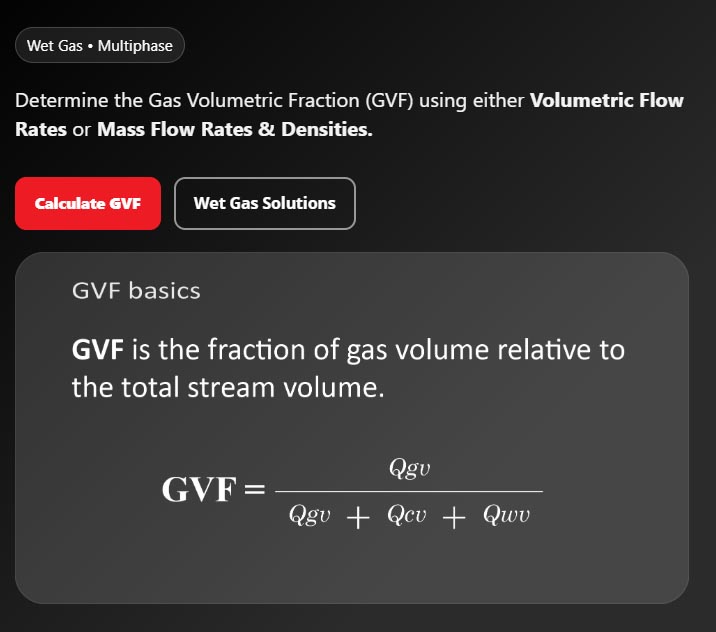
What Is Gas Volumetric Fraction?
GVF is one way of representing the proportion of gas within a multiphase mixture of gas and liquid. Care needs to be taken not to confuse this with Gas Void Fraction, which is also commonly abbreviated to GVF. This ratio directly influences process fluid flow behaviour, pressure drop and phase distribution. Accurate GVF estimation ensures that pipelines and processing equipment operate within safe and efficient parameters and that metering equipment assigned and installed is fit for purpose.
Why does GVF Matter?
GVF impacts pressure profiles and flow regimes, guiding material selection and pipeline component sizing, including, of course, the flow metering device. Compressors, pumps and separators also depend on accurate GVF data for optimal operation. Incorrect GVF calculations can lead to slugging, vibration and equipment failure, increasing operational risk.
In oil and gas operations, chemical processing and multiphase flow systems, precise and accurate data is paramount. Amongst the many variables that engineers monitor and review, Gas Volumetric Fraction stands out as a key indicator for the performance of a well, and as such the whole infrastructure required to process the well fluids. A production well with a high level of liquid (lower GVF) has different requirements to that of a well with high levels of gas (high or very high GVF). GVF plays a vital role in pipeline design, equipment sizing and operational efficiency.
From the perspective of flow metering and understanding process conditions, GVF will most likely determine the type of flow meter best suited to an application's conditions. Solartron ISA's wet gas calculations use the GVF as a top-level indicator for an initial starting point for the flow meter suitability, along with further analysis of the Gas Mass Fraction (GMF), Lockhart Martinelli (LM), and Water-to-Liquid volume ratio (WLR) parameters to further refine suitability.
Typically, a very high GVF application would be 98% - 100% GVF, and high GVF applications 90-100%. Where the GVF is 80%, the dominant process fluid becomes liquid, and therefore no longer gas dominated. This may be considered the boundary of wet gas applications, and other calculated parameters mentioned above may better determine the predominant process conditions.
Methods of Calculation:
The GVF may be determined by:
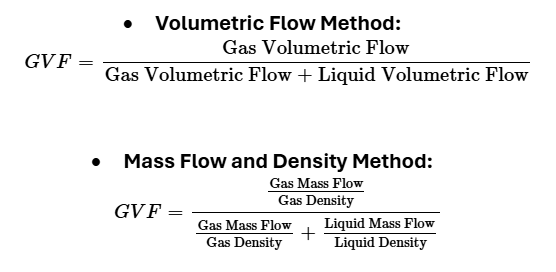
The second method is often preferred where the density of each component is readily available. Regardless of the method, unit consistency and correct density values are essential to avoid errors.
Click here to try the calculator now.
